
Vibe Coding: Warum sich Softwareentwicklung wie Zaubern anfühlt
Reading time: 9 min
From an idea to a working tool—why the most important skill of the future may not be programming, but imagination.
Imagine you had a magic wand. One that could make tedious tasks disappear, turn ideas into working applications, and solve everyday challenges with just a few words. Sound like Hogwarts? Welcome to the world of Vibe Coding.
What sounded like science fiction just a few years ago is already possible today. You describe what you need to an artificial intelligence, and shortly thereafter, it creates an initial, functional prototype. No years of programming experience required. Without a complicated development environment. And often without even writing a single line of code yourself.
Vibe Coding feels like magic. But the real magic isn’t in the wand—it’s in the person wielding it.
Expecto Prototypum: What Is Vibe Coding & How Does It Work?
Until now, software development has worked—to put it simply—like this: You had an idea, needed technical expertise, and then had to translate that idea into a programming language. Or you needed someone to do exactly that for you. With Vibe Coding, this principle is changing fundamentally. The AI translates your natural language into code, creates user interfaces, and implements functions. You look at the result, try it out, and provide feedback. Then it’s refined. For example, you might say:
“Create a digital feedback tool for our workshops. Participants should be able to rate three questions using stars and provide suggestions for improvement. Afterward, I’d like to see a summary with average scores and comments.”
What might once have been a request to the IT department can now be the starting point for a prototype you build yourself. And that is precisely the key difference between Vibe Coding and software development: You no longer need to know how to program every single feature. You need to understand the challenge your application is meant to solve. Of course, secure, scalable enterprise software doesn’t materialize at the push of a button. But the barrier to bringing an idea to life for the first time is significantly lower.
| Criterion | Software Development | Vibe Coding |
| Core Competency | Programming languages (e.g., Python, Java, C++) | Problem Understanding & Prompting |
| Entry Barrier | High (years of education/experience) | Low (natural language is sufficient) |
| Speed/Duration | Weeks to months | Minutes to hours |
| Target Audience | Professional developers | Departments |
The Magic Isn’t in the Wand: Why, in Vibe Coding, It’s the Problem That Matters, Not the Tool
Do you remember the famous scene where Harry Potter gets his first wand? The wand chooses the wizard. In Vibe Coding, I’d rephrase that rule a bit: It’s not the wand that determines the magic. It’s the use case that determines the wand.
After all, there are now numerous AI tools available for developing digital solutions. General-purpose AI assistants help structure initial ideas and prototypes. Specialized no-code and low-code platforms are well-suited for visually appealing web applications, while AI-powered development environments allow for a deeper dive into creating more complex software. But those who focus exclusively on which tool is currently the best are often asking the wrong question.
It’s a bit like a sorcerer’s apprentice spending hours discussing the qualities of different wands without even knowing what spell he wants to cast. That’s why the most important question isn’t, “What can I build with AI?” but rather, “What problem would I like to eliminate from my daily work?”
The biggest challenge? Many people don’t even know what to cook.
In my workshops and conversations, I keep coming across the same question: “That sounds exciting, but what could I actually use Vibe Coding for?” And I think this is precisely where one of the biggest challenges lies. The technology has become so accessible that many people could create their first application in just a few minutes. But most people simply aren’t in the habit of examining their daily work to identify which problems could be solved with a digital solution they developed themselves.
We often think in terms of the tools we already know, rather than the possibilities we actually have. That’s why it sometimes helps to flip the question around. Not: “What cool app could I build?” But rather: “What task annoys me on a regular basis? What’s wasting my time unnecessarily? And where do I find myself thinking, ‘There’s got to be an easier way to do this’?”
Suddenly, ideas start to emerge:
- A small tool that compares two MS Excel lists.
- A dashboard that clearly displays project status and deadlines.
- A generator that creates standardized text blocks from just a few pieces of information.
- An interactive checklist for recurring processes.
- A feedback tool that automatically analyzes evaluations.
None of these applications needs to be particularly complex or innovative. And that’s exactly the point. The best first use case isn’t the most impressive one. It’s the one that solves a real problem. Maybe it only saves you ten minutes a week. But you’ve learned something much more valuable: you no longer have to wait for the right software. You can start designing solutions yourself.
Wingardium Promptiosa: The Art of Casting the Right Spell
Anyone who has ever worked with generative AI is familiar with this phenomenon: Two people use the same tool, ask seemingly similar questions, and get completely different results. The difference often lies in the prompt. In Vibe Coding, this prompt is, in a sense, your magic spell. And just like in a good school of magic, it all comes down to the right wording. A simple “Build me a dashboard” might work. However, the likelihood that the result will actually meet your expectations is fairly low. An effective magic spell requires four ingredients:
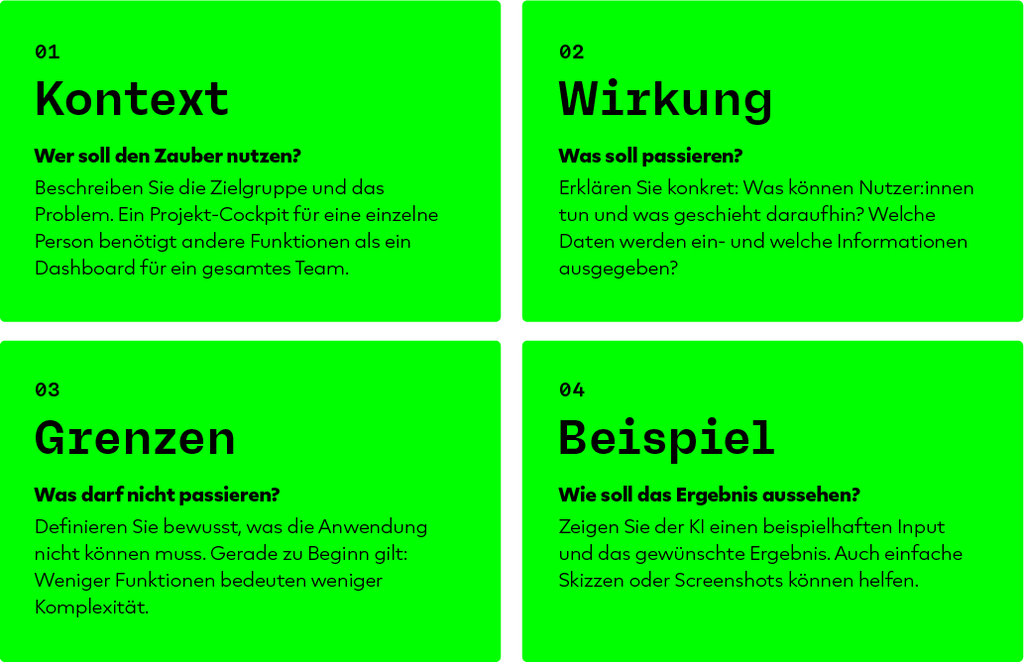
For example, “Build me a dashboard” becomes:
“Create a clear project dashboard for me as the project manager. I want to be able to track five projects, including their names, statuses, and next deadlines. Use a traffic-light system for the statuses and sort the projects by their next deadlines. For now, omit login, notifications, and external interfaces.”
This isn’t a complicated technical instruction. It’s a clear description of what you want to achieve. And this is precisely where an interesting trend emerges: The easier the technical implementation becomes, the more important it is to think precisely and articulate requirements clearly.
The biggest magic mistake? Wanting everything at once
Those first few minutes with Vibe Coding can be impressive. You enter a prompt. The AI gets to work. And suddenly, an application appears that you didn’t even have just a few minutes ago. Your first thought? Wow! The second? If it’s that easy, I might as well add a user management system, five more features, a database, and fully automated reporting right away.
And this is exactly where the problem begins. Just because software can be developed faster doesn’t automatically mean it’s any less complex. Every additional feature brings with it new decisions, dependencies, and potential errors. What starts as a small, working spell can quickly turn into a chaotic cauldron. That’s why I recommend a simple principle: Start by building the smallest version that already delivers tangible value.
Let’s take our feedback tool as an example: In the first step, it’s perfectly sufficient to simply enter ratings and display a basic summary. Does it work reliably? Great. Then, in the next step, you can, for example, add filtering options or improve the user interface. The trick isn’t to create the perfect application with the very first iteration. It’s to develop something that works as quickly as possible and learn from it.
Even magic needs a reality check
A particularly exciting moment occurs when you show the tool you’ve developed yourself to someone else for the first time. What seems perfectly logical to you may be completely incomprehensible to others. Maybe the most important button is barely visible. Maybe certain inputs don’t work. Or a feature behaves differently than users expect. That’s why Vibe Coding involves more than just writing code. It needs a spell check.
Have others test your application—preferably without any prior explanation. Observe where people intuitively find their way around and where they get stuck. And deliberately test for edge cases: What happens if a field is left blank? If someone enters unexpected values? If a calculation needs to account for a special case? This is exactly where the impressive “demo effect” differs from a truly usable solution.
When it comes to enterprise applications, additional questions arise: Where is data stored? What information is permitted to be processed? Who can access the application? Who will maintain it in the long term? A quickly built prototype is not yet a production-ready application. AI can help us build faster. But it does not relieve us of responsibility for what we build.
From Consumer to Creator: How Vibe Coding Is Changing the Business Landscape
In my view, perhaps the most exciting change brought about by Vibe Coding isn’t a technical one. It’s a change in our role. Until now, many employees were primarily users of digital solutions. They worked with the tools provided to them, made do with their limitations, and looked for workarounds. If a specific tool was missing, the only option was often to hope for a future IT project.
Vibe Coding opens up a new possibility: Employees can test out ideas on their own before they turn into a large-scale development project. “We’d actually need a tool for that” can suddenly become “I’ve built an initial prototype.” This doesn’t just change the speed at which ideas can be tested. It also changes the way departments and IT collaborate. Instead of discussing only abstract requirements, teams can use a concrete prototype to figure out what they actually need.
This does not make IT obsolete by any means. On the contrary: its expertise in architecture, integration, data protection, security, and sustainable operations remains crucial. But the early stages of innovation can become more widely accessible. And perhaps this will give rise to an entirely new form of collaboration: business units experiment, validate ideas, and define requirements. Professional development teams help translate successful approaches into robust solutions.
4 Steps to Casting Your First Spell
Want to try Vibe Coding for yourself? You don’t need a magic cloak or a degree in computer science. Get started in four easy steps:
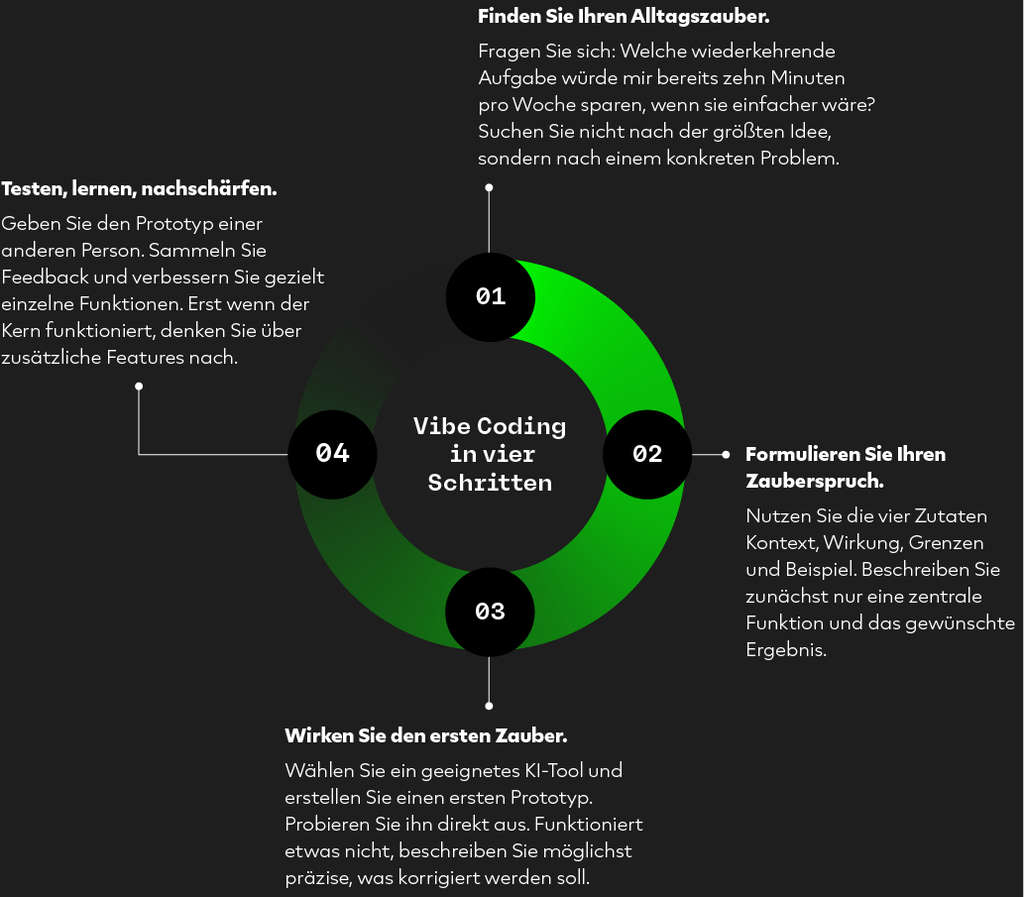
And here’s another little tip: Resist the temptation to try the next tool right away as soon as something doesn’t work. Sometimes you don’t need a better magic wand—you just need a better magic spell.
Be brave: The magic begins with your first try
Vibe Coding won’t turn us into professional software developers overnight. And even the best AI won’t eliminate the need to test, secure, and further develop software. But Vibe Coding is pushing a boundary that has long been taken for granted. The boundary between people who use digital solutions and people who create them. Perhaps that’s the real magic behind Vibe Coding. It’s not that artificial intelligence does the programming for us. It’s that we can suddenly create things we wouldn’t have thought ourselves capable of just a short time ago. We don’t always need the perfect idea, the perfect prompt, or the perfect tool to do this. Above all, we need one thing: the courage to get started. So: Be brave.
Give something a try. Build something small. Make mistakes—there’s a reason they say, “Mistakes are your teachers.” Learn from them. And then try again. Because sometimes you don’t need a polished business case or a major innovation project. Sometimes all it takes is a simple: “What if I could build that myself?” The magic wand is here. Now it’s your turn.
Be brave. Create some magic.
Frequently Asked Questions About Vibe Coding
What are some examples of Vibe Coding?
Typical real-world examples include small tools for everyday work: automated comparisons of Excel lists, interactive project dashboards, digital feedback forms for workshops, simple landing pages, or custom text generators.
What are Vibe Coding tools?
These are AI-powered platforms or programs that automatically translate natural language instructions (prompts) into functional code and user interfaces. They act as an intelligent sparring partner, allowing applications to be created largely without manual code entry.
What are the disadvantages of Vibe Coding?
The challenge lies in quality control and long-term maintenance. Without programming knowledge, it is difficult to check the generated code in the background for subtle logic errors, performance issues, or IT security vulnerabilities. For quick prototypes and small everyday tools, this is usually not a problem—but if an application is to be deeply integrated into business processes or scaled significantly, IT expertise is still required for architecture, data protection, and sustainable operation.
